Manuscript of the Master's Novel
The Manuscript of the Master's Novel is the central symbolic object of Mikhail Bulgakov's The Master and Margarita, a novel about Pontius Pilate and Yeshua Ha-Nozri written by the unnamed master. It is physically burned by its author in a moment of despair, yet miraculously survives, embodying the novel's core themes of artistic integrity, cowardice, and the indestructibility of truth. The manuscript's fate—destroyed and resurrected—directly illustrates the aphorism 'Manuscripts don't burn' and serves as the narrative and moral hinge connecting the master's fate with that of Pontius Pilate.
Creation and the Golden Age
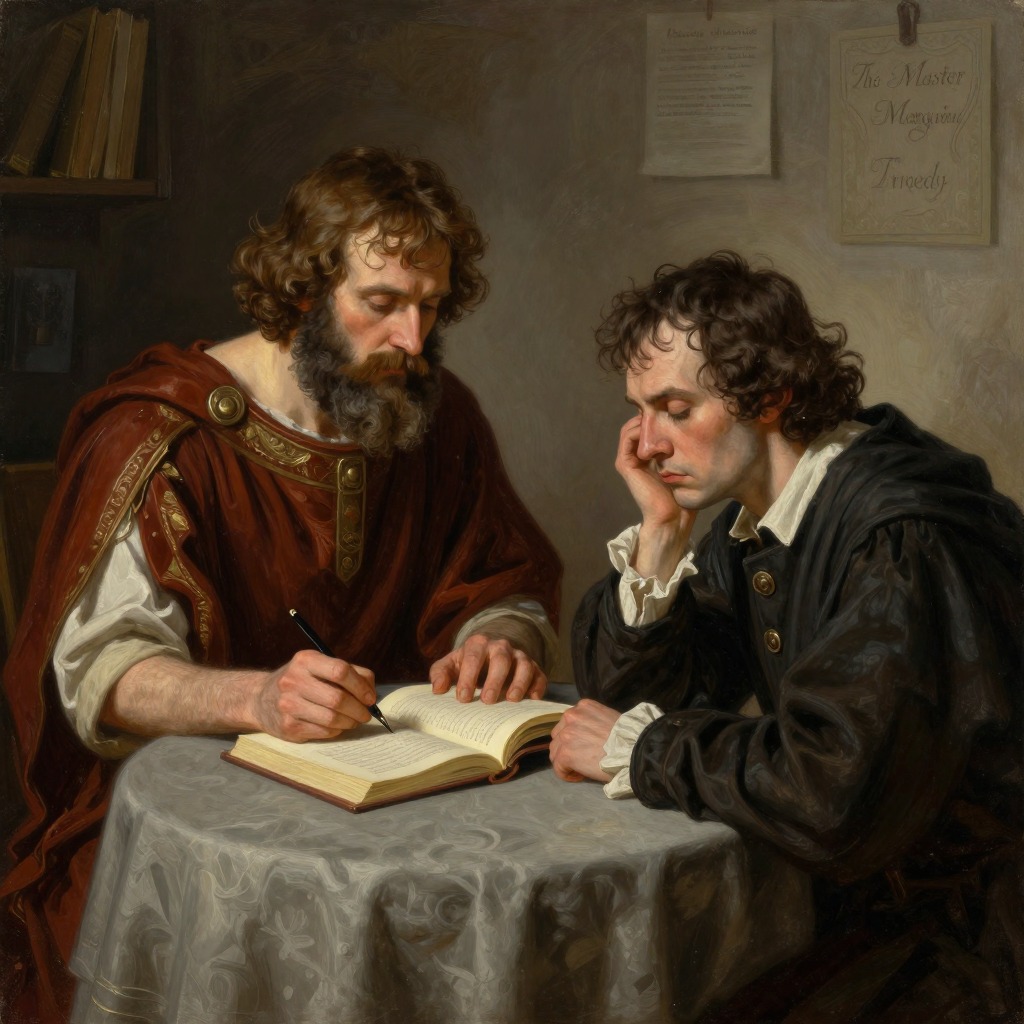
The master, a historian by training who knew five languages, wrote the novel about Pontius Pilate after winning a hundred thousand roubles on a state bond. He quit his job at a Moscow museum and rented two basement rooms in a lane near the Arbat, where he lived in a private, golden age. The novel was his sole occupation, and he worked feverishly on it, with the last words already clear in his mind: '... the fifth procurator of Judea, the equestrian Pontius Pilate'. His secret wife, Margarita, became completely absorbed in the work, endlessly rereading what he had written, urging him on, and calling him a master. She sewed for him a black cap with the letter 'M' embroidered in yellow silk, which he wore as a badge of his identity. The novel was finished in August, and she had it typed in five copies.
Rejection, Criticism, and Despair
When the master took the manuscript into the world of literature, his life ended. The editor who first read it looked at him as if he had a swollen cheek and asked idiotic questions, including who had given him the idea of writing on such a strange theme. The novel was rejected, and soon after, a campaign of vicious criticism began. The critic Ariman warned that the master had attempted to foist an apology for Jesus Christ into print. Mstislav Lavrovich recommended striking hard at 'Pilatism'. The most ferocious attack came from the critic Latunsky, whose article was entitled 'A Militant Old Believer'. The master, reading these articles, passed through stages of laughter, astonishment, and finally fear—not of the articles themselves, but of a deeper, unnamed terror. He began to be afraid of the dark, and felt a cold, pliant octopus stealing towards his heart as he fell asleep.
The Burning and the Resurrection
In mid-October, in a state of mental illness and despair, the master decided to destroy his work. He took the heavy manuscript and the draft notebooks from his desk drawer and began burning them in the stove. The paper burned reluctantly, and he had to tear the notebooks and ruffle the pages with a poker. Familiar words flashed before him as the yellow flame climbed the pages, and he finished them off with the poker. Just then, Margarita scratched at the window. She rushed in, pulled the last burning sheaf from the stove with her bare hands, and threw it on the floor. She wept irrepressibly, but then, full of determination, she collected and smoothed out the burnt-edged pages, wrapped them in paper, and tied them with a ribbon. She declared she would save him and that he would restore the novel. The manuscript, though damaged, was not lost. This moment of fear and destruction directly inspired the novel's famous aphorism, 'Manuscripts don't burn', which seems to express an absolute trust in the triumph of the free word over terror. The manuscript's survival is later confirmed by Woland, who, after the master's release from the clinic, returns the resurrected manuscript to him, saying that 'Manuscripts don't burn'.
Narrative Role and Thematic Significance
The manuscript is not merely a plot device but a multi-layered symbol. It is the product of the master's artistic integrity, written in secret and for its own sake, not for publication or fame. Its rejection and the subsequent persecution of its author mirror Bulgakov's own struggles with Soviet literary censorship. The manuscript's physical destruction and miraculous return embody the novel's central paradox: that truth and art, though vulnerable to violence and fear, are ultimately indestructible. The manuscript also serves as the narrative link between the two worlds of the novel. The Pilate story, which the master wrote, is first told by Woland at the Patriarch's Ponds, then dreamed by Ivan Homeless, and finally read by Margarita. The manuscript's fate is directly tied to the master's own fate: he does not 'deserve the light' but 'deserves peace', a judgment that reflects his act of cowardice in burning his work and abandoning his life. The manuscript, therefore, is the material proof of the master's artistic achievement and the record of his moral failure, a testament to both the power and the fragility of the creative spirit.